How to Avoid Jet Charter Delays: The 2026 Definitive Guide
The promise of private aviation is fundamentally built upon the sovereignty of time. Unlike commercial travel, which operates on the rigid pulse of a hub-and-spoke system, the private jet charter is theoretically designed to bend to the passenger’s schedule. However, as the global airspace grows increasingly congested and the logistics of aircraft maintenance become more complex, the “guaranteed” departure has become a variable rather than a constant. How to Avoid Jet Charter Delays. For the principal, a delay is not merely an inconvenience; it is a systemic failure that ripples through boardrooms, high-stakes negotiations, and family obligations.
In 2026, the mechanics of flight delays have evolved. We are no longer dealing solely with mechanical issues or simple thunderstorms. Today’s friction points include a global shortage of qualified flight crews, strained Fixed Base Operator (FBO) infrastructure, and increasingly stringent air traffic control (ATC) flow management programs designed to mitigate the carbon impact of idling aircraft. To master the art of the on-time departure, one must look past the luxury of the cabin and into the forensic reality of the operational flight plan.
True reliability in the charter market is the result of aggressive pre-flight intelligence and a deep understanding of the “operational chain.” Every flight is a sequence of dependencies: the positioning of the aircraft, the crew’s duty-day legality, the availability of fuel at the departure point, and the slot availability at the destination. This editorial analysis serves as a definitive pillar for those seeking to insulate themselves from these variables. It provides a strategic framework for high-net-worth individuals and corporate travel departments to ensure that the aircraft is ready when the passenger arrives, rather than the other way around.
How to avoid jet charter delays
To accurately address how to avoid jet charter delays, one must first dismantle the oversimplification that delays are accidental. In most cases, a delay is the logical outcome of a choice made during the booking phase. From a multi-perspective explanation, a delay is viewed differently by each stakeholder: for the pilot, it may be a necessary safety margin; for the broker, it is a logistical headache; and for the passenger, it is a breach of contract. Understanding these differing viewpoints is essential for identifying where the system is most likely to break.
A common misunderstanding is the belief that choosing the “newest” aircraft is the best defense against delays. While a new airframe may have fewer mechanical squawks, it often lacks the “recovery infrastructure” that an older, larger fleet might possess. If a brand-new Phenom 300 breaks down in a remote region and the operator only owns one aircraft, you are grounded indefinitely. Conversely, an operator with twenty 10-year-old aircraft has the redundancy to swap a tail number in hours. Reliability is a function of fleet depth, not just manufacturing date.
Oversimplification also plagues the concept of “weather delays.” Many passengers assume that if the sun is shining at the departure airport, there is no reason for a hold. However, ATC delays are often “downstream” issues—congested arrivals in a city 1,000 miles away or a convective weather cell over a critical “gateway” intersection. Avoiding these delays requires a proactive analysis of the entire flight corridor, not just the local forecast. Real-world mitigation involves choosing “reliever” airports that bypass the primary traffic flows of major metropolitan hubs.
Deep Contextual Background: The Evolution of Charter Friction
Historically, private jet delays were primarily mechanical. In the 1980s and 90s, the “on-demand” charter market was a fragmented collection of local operators. If a plane didn’t start, the passenger was essentially out of luck. The 2000s saw the rise of the fractional ownership model (e.g., NetJets), which introduced the “guaranteed recovery” concept. This shifted the industry’s focus from “individual aircraft” to “fleet availability.”
The 2020s, however, introduced systemic stressors. The post-pandemic surge in private travel brought millions of new flight hours into the system, leading to “ATC saturations” that the infrastructure was never designed to handle. Simultaneously, the supply chain for aircraft parts became fragile; a single broken sensor that once took 24 hours to replace might now ground an aircraft for a week.
In 2026, we are in the era of “Crew Legalism.” Because of high-profile fatigue-related incidents, flight crews are more rigid about “Duty Day” limits. If a passenger is 30 minutes late for a 12-hour mission, the crew may “time out” mid-flight, forcing an overnight stop. The modern evolution of the delay is less about the machine and more about the human and regulatory constraints surrounding it.
Conceptual Frameworks for Reliability
1. The “Single Point of Failure” (SPOF) Analysis
This model identifies the weakest link in a mission profile. If you are chartering a unique, one-of-a-kind aircraft for a remote destination, the SPOF is the aircraft itself. If you are flying into a high-density airport like Teterboro (TEB) on a Friday afternoon, the SPOF is the ATC flow. Reliability is achieved by diversifying the “recovery options”—ensuring that a backup plan exists for the specific SPOF identified for that trip.
2. The “Buffer and Slack” Mental Model
In logistics, “slack” is the amount of time a task can be delayed without affecting the subsequent task. Most jet charters are booked with zero slack. The plane arrives from its previous mission 30 minutes before you depart. This framework advocates for “Strategic Buffering”—scheduling your aircraft to arrive at the FBO two hours before your departure. This absorbs the “inbound delay” that accounts for 40% of all charter setbacks.
3. The “Service Recovery” Index
This framework evaluates a charter provider based not on their primary plan, but on their “Plan B.” A high-index provider has pre-negotiated “Interchange Agreements” with other operators. When their jet fails, they have the legal and financial infrastructure to “buy-in” a sub-charter from a competitor to keep you moving.
Key Categories of Charter Providers and Their Trade-offs
Realistic Decision Logic
The “Reliability-Price” curve is non-linear. Paying 20% more for a larger operator often yields a 200% increase in recovery options. If the mission is “Critical” (e.g., a wedding or a closing), the decision logic must bypass brokers who do not have “guaranteed recovery” clauses in their contracts.
Detailed Real-World Scenarios How to Avoid Jet Charter Delays
Scenario 1: The “Teterboro Trap”
A corporate team needs to fly from Teterboro, NJ (TEB) to Chicago Midway (MDW) at 4:00 PM on a Thursday.
-
The Constraint: TEB is the most congested private airport in the world. Departure delays of 60-90 minutes are standard during peak flows.
-
The Solution: Move the departure to Westchester County (HPN) or Morristown (MMU).
-
Failure Mode: Sticking to the most “convenient” airport, resulting in the team sitting on the tarmac for two hours, missing their dinner meeting.
Scenario 2: The “Remote Island” Recovery
A family charters a Midsize jet to a Caribbean island with a short runway.
-
The Constraint: Only a few aircraft models (e.g., Citation Latitude) can safely operate on that runway.
-
The Decision Point: The primary aircraft has a mechanical issue.
-
The Second-Order Effect: Because it’s a “niche” airport, the broker cannot find a replacement aircraft that is already in the region. The family is stranded for 48 hours while a replacement is ferried from Florida.
-
Mitigation: In remote scenarios, always choose a more common aircraft type that has “regional density,” even if it’s more expensive.
Planning, Cost, and Resource Dynamics
The cost of avoiding delays is often “Indirect.” It is found in the “Total Mission Cost” rather than the hourly rate.
Estimated Cost of Delay Mitigation
The Variability of “Mechanical Risk”: Older aircraft (15+ years) typically have a 5% higher mechanical delay rate. While the hourly rate might be $1,000 less, the “Probability-Adjusted Cost” of a delay must be factored in. For a high-stakes mission, the $1,000 savings is a poor hedge against a $50,000 opportunity cost.
Tools, Strategies, and Support Systems
-
FlightAware Global / FlightRadar24: Passengers should track the “Inbound Tail.” If your aircraft is currently in a city with a 3-hour ground stop, you know you have a delay before the broker even calls you.
-
“Deadhead” Avoidance: Strategy where you only book aircraft that are already based at your departure airport, eliminating the “positioning flight” risk.
-
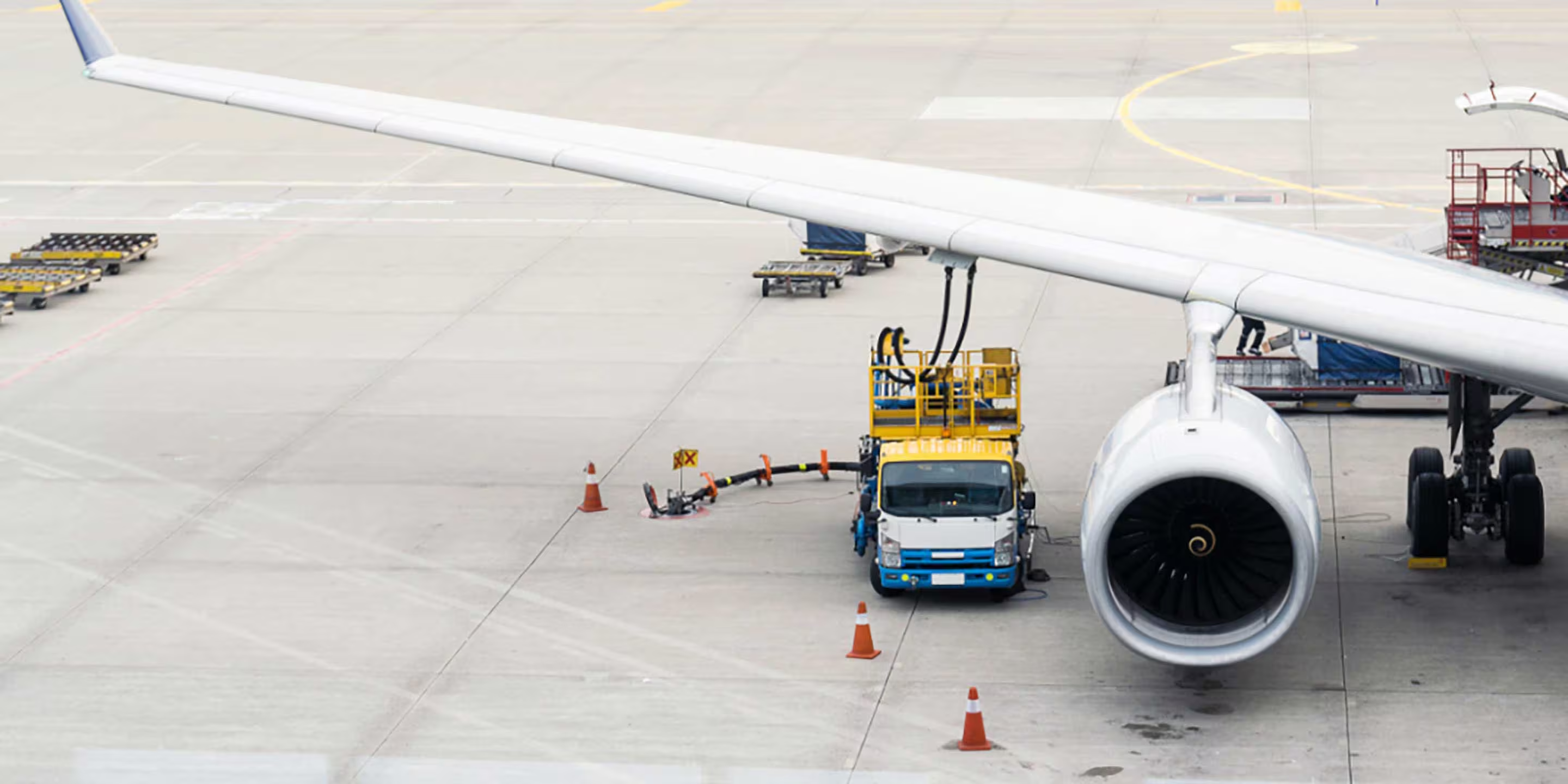
FBO Coordination: Using a “VIP Handling” service that ensures the fuel truck and catering are at the aircraft 60 minutes prior to your arrival.
-
CPDLC (Controller-Pilot Data Link Communications): Ensuring your chartered aircraft is equipped with modern avionics that allow it to receive ATC clearances digitally, bypassing congested radio frequencies.
-
Weather-Sensitive Scheduling: Using tools like “Custom Weather” to identify if your 8:00 AM departure coincides with the morning “marine layer” fog in coastal cities.
-
The “Mechanical Backup” Clause: A specific legal addendum in your charter agreement that requires the broker to provide a replacement aircraft of equal or better category within 4 hours at no additional cost.
Risk Landscape and Compounding Failures
In aviation, failures are rarely isolated; they “cascade.”
-
The Crew/Catering Loop: A 30-minute catering delay causes the aircraft to miss its ATC slot. The new slot is 2 hours later. By the time the plane takes off, the crew is nearing their 14-hour duty limit. They cannot complete the return leg, grounding the passenger in a middle-of-the-road city.
-
The “Short Runway” Compounding Risk: Rain at the destination reduces the “available landing distance.” If the aircraft is at max weight, the pilot may be forced to divert or delay until the runway dries.
-
The “One-Way” Exposure: In one-way charters, the operator is often “chasing” a following mission. If you are 15 minutes late, the operator may be forced to cancel your flight to make their next “guaranteed” contract.
Governance and Long-Term Adaptation
For a corporate flight department or a frequent traveler, avoiding delays is a “Continuous Improvement” process.
-
Quarterly Performance Audits: Every 90 days, review the “On-Time Performance” (OTP) of your preferred operators. If an operator falls below 90% OTP, they should be moved to a secondary tier.
-
Review Cycles for Airports: Analyze which airports in your frequent rotation have the most ATC friction.
-
The “Go/No-Go” Checklist:
-
[ ] Is the inbound aircraft already on the ground at the FBO?
-
[ ] Has the crew been briefed on the specific “Slot” requirements?
-
[ ] Is there a “Backup Tail” identified within a 100-mile radius?
-
[ ] Have the “Reliever Airports” been pre-vetted for runway length and FBO hours?
-
Measurement, Tracking, and Evaluation How to Avoid Jet Charter Delays
You cannot manage what you do not measure. A successful program tracks “Root Cause” analysis for every minute of delay.
Leading vs. Lagging Indicators
-
Leading Indicator: “Average Tail Age” and “Operator Fleet Depth.”
-
Lagging Indicator: “Total Minutes of Delay per 100 Flight Hours.”
Documentation Examples
-
The “Post-Flight Debrief”: A 2-minute form completed by the principal’s assistant to record the actual vs. scheduled “Wheels Up” time.
-
The “Infrastructure Audit”: A log of FBO performance (e.g., how long it took for the luggage to reach the car).
Common Misconceptions and Oversimplifications
-
“The pilot is being lazy.” If a pilot refuses to fly, it is almost always due to a rigid safety or regulatory constraint. Pushing a pilot to “just make it work” is the primary cause of accidents in the charter sector.
-
“Big brokers are always safer.” Some big brokers are “volume shops” that care more about the margin than the specific tail number. A boutique broker with 20 years of experience often has more “clout” with an operator’s owner.
-
“Direct flights are always faster.” On long-haul missions, a tech stop for fuel in a low-traffic airport is often faster than trying to fly a “max-range” mission that requires a slower cruise speed and complex ATC routing.
-
“The contract price is fixed.” If a delay is caused by weather or ATC, the passenger is often liable for the extra “flight time” or “de-icing” costs.
-
“Private jets can land anywhere.” Weight and balance limits, especially in summer heat, often prevent private jets from using the most “convenient” small runways.
-
“Technology has solved delays.” While we have better data, the physical constraints (runway capacity and human fatigue) remain unchanged.
Conclusion
The ability to how to avoid jet charter delays is the ultimate metric of a sophisticated traveler. It requires a shift in mindset from “buying a seat” to “managing a logistical system.” In 2026, the most reliable missions are those that respect the physics of flight and the regulations of the crew while building in the “strategic slack” necessary to absorb the inevitable friction of global travel.
Ultimately, the goal of a charter is not just to fly, but to arrive. By choosing operators with fleet depth, utilizing reliever airports, and insisting on “guaranteed recovery” contracts, the principal can reclaim the sovereignty of their time. In the high-stakes world of private aviation, the most expensive flight is the one that never leaves the ground.